


Views: 0 Author: Site Editor Publish Time: 2026-06-21 Origin: Site


Industrial maintenance and marine engineering operate under intense pressure. Facility downtime costs thousands of dollars per hour. Complex structures like ship hulls, cooling towers, and storage tanks demand highly adaptable access solutions. Standard frames fail to accommodate these awkward shapes. This is where modern modular setups bridge the gap. We introduce cuplock scaffolding as an industry-leading standard. It perfectly balances the pure flexibility of traditional tube-and-clamp setups with the rigid assembly speed of newer systems. Procurement managers and site engineers face tough decisions daily. You need safe, reliable, and cost-effective materials for your crews. Our purpose here is to deliver a verifiable, technical framework for your next project. We will help you evaluate and source the right system for harsh environments. You will learn how node mechanisms maximize safety, why material grades dictate performance, and how to verify supplier compliance thoroughly.
Cuplock's unique node mechanism allows up to four horizontal components to connect to a single vertical standard, making it structurally ideal for the curved profiles of shipyards and industrial tanks.
Material selection dictates lifespan and safety; balancing Q235 steel grades with the correct surface finish (painted vs. galvanized) is critical for ROI.
Evaluating a construction scaffold system requires looking beyond unit cost to factor in load stability, component traceability, and supplier compliance with international safety standards.
The unique access challenges found in refineries, offshore platforms, and shipyards demand specialized engineering. You routinely encounter highly confined spaces and complex pipe racks. Cylindrical structures make straight-line access platforms impossible to build. Furthermore, dynamic wind forces and heavy weight loads place immense, constant stress on temporary frameworks. Traditional scaffolding struggles to adapt to these specific curves and pressures safely. The locking cup principle offers a brilliant mechanical advantage. Cuplock nodes securely clamp horizontal ledgers and vertical standards together without loose parts. A bottom cup is welded directly to the vertical standard. The worker inserts the ledger blade into this bottom cup. A sliding top cup then drops down over the blades. A simple hammer blow rotates and locks the top cup tight. This absence of loose fittings significantly reduces drop-hazards. Workers avoid dropping heavy clamps over open water or into sensitive industrial machinery below. This system beautifully balances adaptability with speed. The modular design allows for rapid erection around complex geometries. Crews easily construct circular towers around chemical storage tanks. Importantly, they do not sacrifice structural integrity to gain this speed. Fixed node spacing guarantees perfect vertical alignment automatically. Your teams work faster while maintaining a rigorously safe geometric shape.
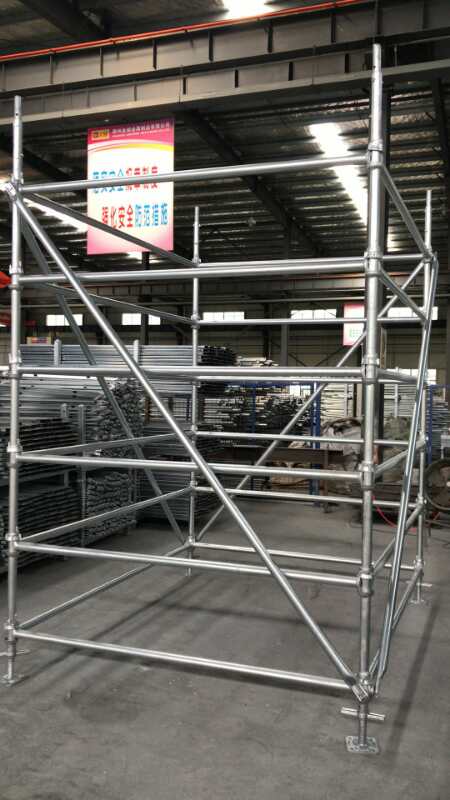
Steel grades define the baseline performance of your access equipment. Procurement teams must understand these metallurgical metrics. A reliable Q235 cuplock scaffolding setup delivers excellent ductility. Mild carbon steel absorbs operational shocks and slight deflections effectively. Some heavy-duty environments require high-tensile steel alternatives, like Q345, for greater strength. Steel grade directly impacts your weight-to-load capacity ratio. Lower-grade steel requires thicker tube walls to meet safety capacities. Thicker walls mean heavier tubes. Heavier tubes increase worker fatigue during assembly. They also increase the dead load resting on delicate ship decks or tank roofs. Conversely, higher yield strength allows for thinner, lighter tubes that maintain the same load rating. You must carefully balance tube weight against your required heavy-duty application needs.
Surface finishes dictate the longevity and safety of your system. Marine environments unleash severe salt corrosion on bare steel. Hot-dip galvanized (HDG) finishes provide superior protection for these conditions. The zinc coating covers both the outside and the inside of the tubes. This complete coverage prevents internal rusting, which often goes unnoticed until catastrophic failure occurs. A painted cuplock scaffold remains highly viable for specific contexts. You often use painted systems for inland, controlled industrial maintenance. Paint costs less upfront and provides adequate protection away from saline moisture. Paint also clearly identifies different equipment batches visually. Below is a chart summarizing surface finish comparisons:
Surface Finish | Primary Application | Corrosion Resistance | Visual Batch Identification |
|---|---|---|---|
Hot-Dip Galvanized (HDG) | Shipbuilding, Offshore, Coastal | Excellent (Internal and External) | Low (Uniform Silver/Grey) |
Powder Coated / Painted | Inland Refineries, Dry Maintenance | Moderate (External Only) | High (Custom Colors Available) |
Active shipbuilding sites generate massive dynamic loads. Tower cranes place heavy marine components near temporary access platforms. Workers constantly move bulky welding equipment across the bays. Therefore, load distribution capabilities must remain flawless under pressure. Cuplock excels at distributing these loads safely. Each node locks up to four ledgers securely into one standard. This action disperses applied weight evenly down the vertical columns. Evidence-based testing shows minimal deflection under heavy dynamic loads. Bracing configurations enhance this inherent stability further. Diagonal braces absorb lateral wind shears. They keep the structure rigid beside towering ship hulls, ensuring workers feel secure at extreme heights.
Procurement teams must evaluate every construction scaffold system objectively to ensure project success. Ringlock vs. Cuplock Ringlock systems use distinct rosette geometries. They allow up to eight connections per node. This offers extreme angle flexibility for highly irregular shapes. However, Cuplock often provides a more cost-effective modularity. The learning curve for Cuplock is exceptionally flat. Existing scaffolding crews adapt to the sliding cup mechanism instantly. Cuplock handles 90-degree corners and basic curved circular setups perfectly well without the added cost of complex rosettes. Tube & Clamp vs. Cuplock Traditional tube and clamp methods maximize pure flexibility. They can fit into almost any awkward gap in a refinery. Yet, they consume massive amounts of labor hours. Workers must measure, level, and tighten every single loose connection manually. Human-error risks multiply rapidly in these setups. Upgrading to a modular Cuplock system slashes erection times. Standardized node intervals eliminate measuring guesswork. Safety increases dramatically because the system enforces exact structural geometry automatically. Decision Matrix We provide transparent assumptions for choosing the right system:
Project Scenario | Recommended System | Reasoning |
|---|---|---|
High-volume, curved storage tanks | Cuplock | Budget and adaptability are parallel priorities. Flat learning curve speeds up assembly. |
Highly complex, multi-angled offshore rigs | Ringlock | Requires connection angles beyond 90 degrees. Budget allows for premium nodes. |
Extremely tight, non-standard boiler internals | Tube & Clamp | Requires millimeter-specific placement where modular fixed nodes will not fit. |
Mixing components from unverified manufacturers invites disaster. Different factories use varying manufacturing tolerances. A bottom cup from brand A might not tightly secure a ledger blade from brand B. This tiny tolerance mismatch leads to joint movement. Joint movement causes eccentric loading, which eventually leads to node failure and column buckling. Always source your entire system from a single, verified producer to guarantee tight node tolerances.
Heavy industrial use demands rigorous material traceability. You must insist on regular batch testing from your suppliers. * Factory Stamps: Components should feature clear factory stamps. Stamped parts allow rapid identification during site audits. * Mill Certificates: Verifiable mill certificates prove the chemical composition of the steel. * Batch Reports: Request documentation showing physical yield tests. Do not accept materials without proper documentation. If an accident occurs, traceable components protect your firm during investigations.
Your chosen shipbuilding scaffold must align with regional safety mandates strictly. OSHA outlines clear rules for maximum free-standing heights. EN 12811 standards comprehensively govern safe working loads (SWL) for modular systems. Your framework must meet required tie-in rules. Marine environments experience high wind forces constantly. The temporary framework must anchor securely to the ship hull or dry-dock walls. Compliance guarantees worker safety. It also protects your engineering firm from severe legal liability.
Dry-dock operations demand high volumes of materials instantly. Delays paralyze the entire project timeline. You must assess your supplier's actual production capacity carefully. 1. Ask about their monthly tonnage capabilities. 2. Inquire about raw material stockpiles. 3. Check their historical delivery times for large orders. A reliable supplier of industrial scaffolding maintains robust inventory. They scale production rapidly to meet your massive project demands without lead-time blowouts.
Reliable manufacturers implement strict QA/QC checkpoints at every stage. Weld penetration testing guarantees node strength under tension. Without deep weld penetration, the bottom cup can shear off the standard. Galvanization thickness checks ensure long-term corrosion resistance matches international ISO standards. You should request detailed quality manuals from potential suppliers. Audit their factory testing equipment if possible. Consistent manufacturing quality separates premium suppliers from risky, low-budget vendors.
Choosing the right cuplock scaffolding requires balancing environmental realities with hard material facts. You must match severe marine corrosion with galvanized finishes. You must counter dynamic structural loads with verified Q235 steel performance. Cuplock provides the ideal combination of adaptability and speed for complex industrial setups. As a next step, we encourage buyers to audit their current scaffolding labor costs. Calculate the hours lost to traditional tube-and-clamp measuring. Request technical specification sheets and sample batch testing reports from potential cuplock suppliers. Validate their production capacities and quality assurance methods carefully before issuing a final purchase order.
A: Standard Q235 systems typically support Heavy Duty load classes (up to 3 kN/m² or higher), depending strictly on the design. Actual capacity always depends on ledger lengths, vertical spacing, and diagonal bracing. Always consult a certified engineer to calculate exact safe working loads for your specific configuration.
A: Paint offers limited protection in highly saline environments. Saltwater rapidly penetrates paint scratches, causing hidden rust. We highly recommend hot-dip galvanization for marine and shipbuilding projects. You should reserve painted systems for dry, inland industrial maintenance where moisture exposure is heavily controlled.
A: The circular design of the locking cup allows ledgers to pivot slightly before locking. This variable angle allowance accommodates non-linear erection smoothly. Crews can connect ledgers at gentle angles to create a continuous polygon structure that perfectly hugs the curved profile of a storage tank.
A: Yes, hybrid use is possible for custom tie-ins or awkward gaps. You can use standard scaffold tubes and couplers to brace the cuplock structure. However, the core load-bearing columns and levels must remain uniform cuplock to maintain the system's certified stability and manufacturer load ratings.


