


Views: 0 Author: Site Editor Publish Time: 2026-06-30 Origin: Site


Shoring provides the critical backbone for slab and beam construction. It holds the massive weight of wet concrete securely. It keeps the entire structure stable until the material cures properly. Integrating a U head design offers a specific advantage. It perfectly secures primary beams like H20 timber or steel beams. Traditional flat props often struggle during this task. Improper prop selection leads directly to lateral instability. It causes dangerous formwork deflection. It can also cause catastrophic concrete blowouts. You then face increased labor time for constant leveling. These failures delay projects and threaten overall site safety. This article guides procurement teams and site engineers. We provide a verifiable framework to evaluate and source an adjustable steel prop with U head. You will learn how to balance load-bearing safety, strict compliance, and material longevity. We aim to equip you with the exact criteria needed for reliable support.
The U head design physically locks structural beams in place, eliminating the lateral shifting risks inherent in flat-plate props.
Evaluation must prioritize verifiable load capacities, material yield strength (e.g., Q235 vs. Q345), and thread durability over baseline unit cost.
Compliance with recognized standards (such as EN 1065) and transparent factory QA testing are mandatory requirements for shortlisting a supplier.
Traditional flat props create unique challenges on busy construction sites. They require extra bracing to stay secure. Workers must nail beams down directly into the flat plates. This process prevents unwanted movement. However, it adds unnecessary labor hours. It also introduces significant human error. Nailing damages the timber beams over time. If a worker misses a nail, the beam can slide. Friction alone cannot hold heavy structural loads reliably. You need a more secure connection method.
The U head solution changes this dynamic entirely. The U-shaped bracket cradles primary bearers tightly. Standard sizing dimensions match industry-standard beams perfectly. Most U heads accommodate standard H20 timber beams without gaps. The vertical side plates of the U head act as physical barriers. They stop the timber from twisting. You do not need extra nails. The design creates a secure, interlocking formwork support system automatically.
This specific connection point impacts structural integrity deeply. It channels vertical loads straight down the prop axis. Gravity pulls the weight directly into the thick steel tube. This direct transfer prevents eccentric loading. Eccentric loads happen when weight sits off-center. They cause props to bend rapidly. The U head mitigates horizontal drift during the concrete pour. Wet concrete moves violently as it flows. The U head holds the framing rigid against these dynamic forces.
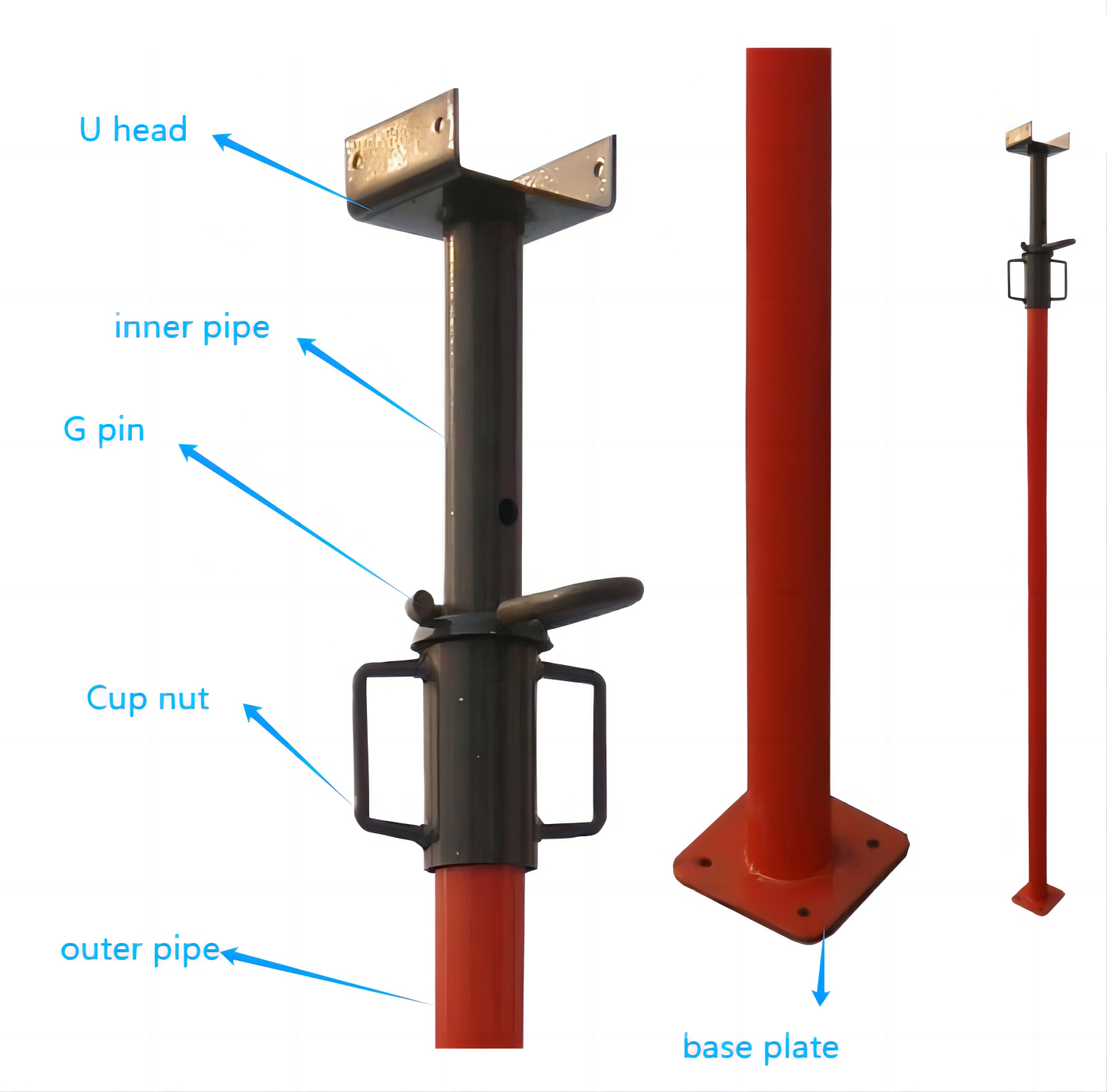
You must address the severe buckling risk at full extension. Props lose strength as they extend higher. A fully extended prop bends much easier than a closed one. You cannot rely on the closed load rating. You must verify safe working loads at the maximum height. The critical ratio between inner and outer tube wall thickness matters most here.
A high-quality steel shoring prop utilizes robust steel tubes. Standard props often use 1.8mm wall thickness. Heavy-duty props demand 2.5mm to 3.0mm thickness. The thicker outer tube prevents the inner tube from swaying. A tight clearance between the two tubes reduces internal play. When tubes fit snugly, the prop stays perfectly vertical. This alignment directly dictates the verifiable safe working load.
You should always compare carbon steel grades before purchasing. Manufacturers typically offer Q235 or Q345 steel. Q235 acts as standard mild steel. It works fine for low-height residential projects. However, Q345 represents a high-yield steel grade. It handles significantly more stress before deforming permanently.
Specifying high-yield steel dictates actual field performance. Wet concrete drops from pumps with massive force. This creates sudden dynamic pouring loads. Q345 steel absorbs these shock waves effectively. It bounces back without permanent bending. Investing in higher material grade ensures your props survive harsh conditions. Weak steel bends easily. Bent props cannot return to service safely.
Threads dictate daily usability on a construction site. You must evaluate the durability of the collar nut carefully. Wet concrete splashes constantly onto exposed threads. If a prop uses standard tight threads, concrete cures inside the grooves. Workers often hammer the collar nut to break the concrete. This hammering destroys the adjustment mechanism quickly.
We highly recommend self-cleaning threads. They feature wider grooves. Wet concrete easily flakes off them as the nut turns. You also need robust locking pins. G-pins provide rapid adjustments for quick setup. Chain pins prevent loss on messy sites because they attach directly. Micro-adjustments must remain viable after severe exposure to debris. Cast iron collar nuts resist hammer impacts better than pressed steel versions.
Surface treatments protect your investment from rapid rust. You must contrast hot-dip galvanizing, electro-galvanizing, and powder coating. Hot-dip galvanizing immerses the steel in molten zinc. It coats the inside and outside of the tubes completely. Electro-galvanizing applies a thinner zinc layer via electrical currents. Powder coating bakes colored paint onto the exterior only.
You should frame this choice around the project lifecycle. Climate exposure ruins unprotected steel fast. Coastal projects face intense salt corrosion. Humid environments accelerate rust inside the tubes. Hot-dip galvanizing offers the longest lifespan. Powder coating looks good initially but chips under heavy impact. We prepared a summary chart below to clarify these differences.
Surface Treatment Method | Corrosion Resistance Level | Best Project Use Case |
|---|---|---|
Hot-Dip Galvanizing | Very High (Internal & External) | Long-term projects, harsh weather, coastal sites |
Electro-Galvanizing | Medium (Thin Layer) | Short-term projects, moderate climates |
Powder Coating / Painted | Low to Medium (Exterior Only) | Indoor projects, dry climates, single-use |
A reliable slab support prop requires precise spacing calculations. You cannot guess where to place them. You must calculate spacing based on actual load data. We provide a straightforward framework for these calculations.
Determine the concrete volume. Multiply slab thickness by the area.
Calculate the dead load. Wet concrete weighs roughly 2400 kg per cubic meter.
Add the live load. Account for workers, concrete pumps, and vibrating tools.
Add the formwork weight. Include your timber beams and plywood sheets.
Divide the total load by the prop's safe working capacity at your target height.
Thick slabs require props placed much closer together. Deep concrete beams focus intense weight onto narrow lines. You must cluster props tightly under these deep beams. Always consult structural engineers for final spacing charts.
Projects rarely feature uniform ceiling heights. A parking garage might have three-meter ceilings. The lobby might reach five meters. You need an inventory that adapts quickly. Guide your procurement by selecting standard prop classes. The EN 1065 standard defines specific classes like Class A, B, C, D, and E.
Class B props handle standard residential heights easily. Class D props support heavier loads at greater extensions. You should mix classes intelligently. This ensures fleet scalability. A versatile inventory scales across different floor-to-ceiling heights. You avoid requiring excess inventory sitting idle. Proper planning keeps your equipment actively deployed.
Your new props must work alongside existing equipment. Construction companies accumulate various shoring parts over time. Ensure the selected U head prop integrates seamlessly. The U head must fit your current primary and secondary beam inventories perfectly.
Check the base plate dimensions carefully. They must fit inside your existing shoring tripods. Tripods hold the props upright during initial placement. If the base plate is too wide, the tripod cannot grip it. Forkheads also swap onto modular props sometimes. Verify standard tube diameters to guarantee component interchangeability. Compatibility prevents emergency orders for mismatched accessories.
We must address site safety seriously. The over-extension fallacy plagues many construction sites. Workers sometimes push props past their engineered safety limits. They extend the inner tube until barely any overlap remains. This creates a highly unstable pivot point. The inner tube can easily snap under pressure.
You must ensure your props include built-in safety stops. Safety stops prevent the inner tube from sliding out entirely. They guarantee a minimum overlap inside the outer tube. This overlap maintains rigidity. Never bypass safety stops to gain extra reach.
Verification of standards protects your workforce. Instruct buyers to request independent load test reports. They should demand compliance certificates. Look for the EN 1065 standard or equivalent local codes. Avoid relying solely on basic manufacturer spec sheets. You need rigorous third-party validation.
Best Practice: Always test a random sample from every new batch delivered.
Best Practice: Train workers to read load charts based on extension heights.
Common Mistake: Using bent props just because they still adjust.
Common Mistake: Ignoring independent certification to save time.
Site-level execution risks require constant monitoring. Deploying props at significant heights amplifies danger. You must use proper diagonal bracing. Tripods provide temporary stability during setup. Scaffolding frames offer permanent bracing for tall pours. Cross-bracing ties the props together. They act as a unified system rather than individual poles. This reinforces an evidence-oriented safety culture.
Sourcing a reliable adjustable prop requires strict vendor evaluation. You must audit the manufacturer's quality assurance process. Ask targeted questions during initial meetings. Inquire about their welding quality checks. Robotic welding provides consistent seams. Manual welding often varies in quality. Ask about their raw material sourcing. Do they buy premium steel coils or cheaper recycled scrap?
Request their batch testing protocols. Good factories crush-test samples from every production run. They should willingly share these destruction test videos. Sampling and prototyping are absolutely essential. Advise your team to order physical sample units. You must hold the product before ordering thousands.
Inspect the weld seams physically. Look for smooth, continuous metal lines. Porosity or gaps indicate weak joints. Test the thread smoothness yourself. Spin the collar nut up and down fully. It should move freely without catching. Measure the U head dimensional tolerances. Ensure your timber beams actually fit inside without forcing them.
Evaluate lead times and factory scalability. Project schedules change rapidly. Construction phases peak quickly. Your supplier needs high production capacity. A small factory might struggle with bulk orders. This prevents massive project delays during critical pours. Reliable suppliers hold safety stock for immediate shipping.
Selecting the right U head prop involves serious risk management. It directly boosts operational efficiency. It is never just a basic commodity purchase. The U head secures your primary beams flawlessly. It eliminates dangerous lateral shifting completely. High-yield steel and self-cleaning threads guarantee reliable field performance. Verifiable load capacities keep your workers safe.
You must prioritize independent testing. Reject undocumented equipment instantly. Hot-dip galvanizing protects your assets across many harsh winters. You should actively audit your current shoring prop failure rates today. Identify where cheap props cause expensive delays. Request verifiable load charts from prospective vendors immediately. If you face complex geometry, contact a structural specialist. They can provide a site-specific formwork calculation. Upgrade your support system to ensure seamless, safe concrete pours.
A: A U head prop features vertical side plates. These plates physically cradle and contain primary structural beams like timber. This prevents lateral sliding naturally. A standard flat head prop only provides a flat surface. Flat plates require extra nailing or friction to hold beams, increasing setup time and shifting risks.
A: You must consult the manufacturer's certified load charts. Safe working loads decrease significantly as the prop extends higher. The rating depends heavily on the tube wall thickness, material grade, and overlap length. Never assume the closed-height capacity applies to an extended prop.
A: Yes, but you must specify heavy-duty models. Civil works require massive load capacities. You should use high-yield steel props with thick tube walls. For extreme civil loads, engineers often combine these props with heavy-duty scaffolding frames to create a highly engineered, unified support system.
A: Threads usually fail due to concrete buildup. Standard tight threads trap wet concrete. Workers then hammer the nut to loosen it, destroying the metal. You prevent this by choosing self-cleaning threads with wide grooves. Regular maintenance and applying release agents also extend thread life significantly.


