


Views: 0 Author: Site Editor Publish Time: 2026-06-16 Origin: Site


Specifying the wrong scaffolding system inflates labor costs. It delays project timelines. It also creates severe compliance risks. Procurement managers and site engineers face tough decisions daily. You need systems balancing worker safety against budget constraints. The right equipment keeps crews productive. The wrong choice brings work to a grinding halt.
Both frame and modular systems remain undeniable industry standards. However, their value diverges sharply on the job site. Project geometry dictates structural needs. Load requirements limit your choices. Project duration shifts the financial math. Relying on habit rather than data hurts profit margins.
This comparison helps you evaluate your options objectively. We strip away marketing claims to focus on structural reality. You will learn exactly which system aligns best to your specific facade and maintenance requirements. Explore how each design handles complex geometry, dynamic loads, and daily operational logistics.
Frame scaffolding offers the lowest upfront cost and fastest erection times for straightforward, linear building profiles and routine maintenance.
Ringlock scaffolding provides superior structural rigidity and multi-directional adaptability, making it essential for complex geometries, industrial sites, and heavy-duty load-bearing needs.
Mobility vs. Scale: Simple rolling towers favor frame designs, whereas full-scale architectural wraps require the engineered node strength of modular systems.
Engineers design scaffolding to transfer loads safely to the ground. Every system achieves this goal differently. Comparing their underlying architecture reveals why they perform differently under stress. You must understand the mechanics before comparing costs.
Traditional systems use welded, pre-fabricated steel units. Manufacturers build them as "H" frames or "walk-through" frames. Crews connect these vertical units using diagonal cross braces. This fixed geometry creates a rigid, repeating box structure. The system relies heavily on standardized, fixed dimensions. This simplicity limits adaptability but guarantees rapid vertical stacking.
Workers simply slide one frame on top of another. Gravity and simple coupling pins hold the structure together. When you establish your baseline access strategy, frame scaffolding provides the simplest structural equation. It demands minimal mechanical fasteners. This straightforward architecture requires very little technical assembly knowledge.
Modular systems discard rigid pre-fabricated frames. They rely on independent vertical standards and horizontal ledgers. The true engineering marvel lies in the rosette node system. Manufacturers weld these rosettes onto vertical tubes at regular 500mm intervals. Each rosette node allows up to eight independent connections.
Workers attach ledgers and diagonal braces at varying angles. You can create circular wraps, irregular shapes, and custom load-bearing grids. Hammer-driven wedge pins lock the components into place. This architecture maximizes structural rigidity. The interlocking wedges prevent ledger movement under dynamic loads. You build the exact shape your project requires.
Understanding where a system excels prevents costly misapplications. Traditional frames dominate specific construction sectors. Their design offers distinct operational advantages for straightforward tasks.
Crews assemble pre-welded frames rapidly. Flat terrain and straight elevations amplify this speed. Two workers can erect a linear run of frames much faster than connecting individual modular pieces. The system offers a remarkably low barrier to entry. New laborers require minimal training to understand the assembly sequence.
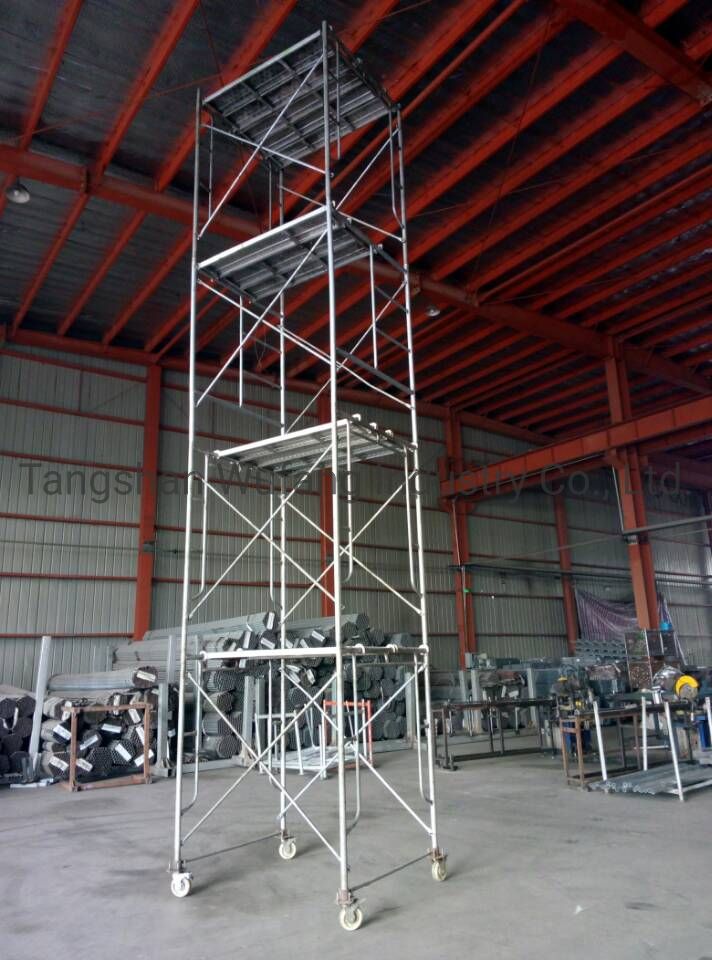
Standard commercial painting projects benefit greatly from this speed. Masonry work on straight walls also suits the repeating box design. Contractors rely on these systems for rapid deployment during localized building repairs. For indoor tasks, a mobile scaffold frame provides excellent utility. Crews can push the structure from room to room effortlessly.
Dynamic, low-level access requires mobility. Manufacturers design these systems to integrate seamlessly as a scaffold with ladder and wheels. Workers lock the casters, climb the integrated rungs, and perform the work. They then unlock the wheels and roll to the next task.
Inflexibility around architectural protrusions: Fixed frames cannot easily hug curved facades. Balconies disrupt the repeating grid. Crews often resort to dangerous, non-compliant workarounds.
Lower ultimate load capacities: Simple coupling pins lack the structural rigidity of wedge-locked nodes. These systems cannot support heavy industrial machinery or massive stone palettes safely.
Height restrictions: Standard frames lose lateral stability at extreme heights compared to engineered modular nodes.
Complex engineering challenges demand robust solutions. Modular rosettes provide the strength and flexibility required for demanding industrial applications. The system handles irregularities effortlessly.
Multi-angle flexibility defines this system. The eight-hole rosette allows connections at 45-degree and 90-degree angles. You can navigate tight corners easily. The wedge-pin mechanism guarantees exceptional node rigidity. This rigidity translates directly to higher weight tolerances. Workers feel zero sway when walking on high-elevation platforms.
Complex industrial facilities demand modularity. Pipe racks and boilers rarely feature straight lines. Offshore oil rigs require systems capable of withstanding intense dynamic wind loads. Irregular architectural shapes practically mandate a rosette system. Heavy masonry and stone-setting projects also rely on its superior load-bearing capacity.
Higher initial material cost: Engineering tight-tolerance rosettes and wedge pins costs more. You pay a premium for the structural flexibility upfront.
Increased complexity in inventory management: Yards must track thousands of individual ledgers, braces, and standards. Missing a specific diagonal length halts site progress. Bulk frames are much easier to count and stack.
Steeper learning curve: Workers must understand grid layouts and node engineering. Incorrect ledger placement compromises the entire tower.
Smart procurement requires objective benchmarking. You must evaluate systems across multiple operational dimensions. Use the chart below to compare baseline characteristics.
Evaluation Criteria | Frame Scaffolding | Ringlock Scaffolding |
|---|---|---|
Labor Efficiency (Straight Walls) | Excellent. High speed of assembly. | Moderate. Slower connection of individual pieces. |
Labor Efficiency (Complex Shapes) | Poor. Requires cumbersome workarounds. | Excellent. Easily adapts to corners and curves. |
Inventory Management | Simple. Fewer, larger components. | Complex. High volume of individual parts. |
Load Capacity | Standard duty. Light masonry, painting. | Heavy duty. Industrial, stone setting. |
Labor speed depends entirely on building geometry. Frame systems win decisively on straight, flat elevations. Pre-welded vertical sections save countless hours. However, complex walls reverse this advantage entirely. If a building features deep recesses or rounded corners, modular systems win. Ringlock eliminates the need for slow, traditional tube-and-clamp workarounds. Workers simply angle the ledgers to follow the building shape.
Buyers frequently struggle balancing initial purchase costs against long-term operational expenses. Traditional frames represent a low Capital Expenditure (CapEx). You buy bulk steel cheaply. Conversely, modular components require a significant upfront budget. However, you must factor in labor hours. Modular systems drastically reduce assembly time on difficult sites. Over multiple complex jobs, reduced labor hours offset the initial premium.
Site safety remains non-negotiable. Modern modular systems feature engineered fall-protection integration. Ledgers serve as precise guardrails. The wedge-pin node maintains stability under severe dynamic wind loads. This makes them ideal for demanding facade scaffolding environments. Standard frames comply with OSHA/EN regulations easily for basic tasks. However, extending them beyond their intended load limit frequently violates safety codes.
Yard footprint influences logistics costs. Frames stack well but consume significant volumetric space. You ship a lot of empty air on flatbed trucks. Modular components pack densely. Workers palletize ledgers and standards into tight bundles. This dense packaging maximizes truck payloads and minimizes yard storage requirements.
Aligning the equipment with the exact project scope maximizes profitability. Applying the wrong system guarantees budget overruns. Review these common scenarios to guide your equipment selection.
Speed to access acts as your primary Key Performance Indicator (KPI) here. HVAC repair, lighting replacement, or minor patching rarely requires massive load capacities. We recommend deploying a frame scaffold tower for these tasks. Crews unload the frames and build the platform in minutes. For localized, short-term maintenance scaffolding, nothing beats the speed of dropping cross braces onto pre-welded pins.
Multi-story renovations introduce complex variables. Workers must navigate varying elevations, protruding balconies, and heavy material staging areas. We strongly recommend Ringlock for these long-duration projects. The rosette nodes handle the immense dead load of stacked brick and mortar. The flexibility allows contractors to fully encapsulate the building tightly, preventing weather delays and protecting pedestrians below.
Rental companies and large contractors must adapt to regional market demands. If your region focuses on suburban residential development, expanding your frame inventory makes sense. If urban commercial construction dominates your market, transition your fleet to system scaffolding. Industrial clients outright reject standard frames for safety reasons. Upgrading to modular systems unlocks high-margin industrial contracts previously inaccessible to your sales team.
Choosing scaffolding is not about declaring one system universally "better." The decision relies entirely on mapping equipment capabilities to your specific project profile and labor economics. Recognizing your daily operational constraints prevents costly equipment mismatches.
Take these action-oriented next steps before purchasing or renting:
Audit your typical site geometries to determine the percentage of linear vs. complex walls.
Conduct a strict labor-to-material cost analysis for your upcoming quarter.
Evaluate your yard storage constraints and transport truck capacities.
Assess the specific load requirements of your masonry or finishing teams.
Stop letting habit dictate your site safety and profitability. Consult an engineering specialist to analyze your structural needs today. Request a tailored quote to see exactly how equipment choices impact your bottom line.
A: Mixing different systems poses severe structural and safety hazards. Manufacturers strictly prohibit bridging frames with modular ledgers. The node connections, steel grades, and load distribution geometries do not align. Mixing parts voids manufacturer warranties and assumes massive liability. Always erect standalone towers if both systems share a job site.
A: Ringlock provides significantly better safety for high-wind environments. The wedge-pin rosette nodes eliminate joint play, ensuring ultimate rigidity. Engineers can calculate exact wind-load tolerances and easily integrate tie-in anchors to the building facade. Standard frames lack the engineered connection strength necessary to withstand continuous, severe wind buffering.
A: Standard frames configured with heavy-duty locking casters work best. They provide rapid deployment for painting, drywall, or ceiling repairs. The rigid, pre-welded design keeps the tower stable during relocation. Crews simply roll the platform between work zones, lock the wheels securely, and immediately resume production.


