


Views: 0 Author: Site Editor Publish Time: 2026-06-12 Origin: Site


Complex architectural geometries—like circular tanks, curved glass facades, and undulating towers—expose the limitations of traditional scaffolding through dangerous gaps and inefficient assembly times. Rigid, straight lines struggle to hug these flowing structures safely. You often see alarming wall distances and unstable platforms as a result. For procurement leads and site engineers, selecting the right system requires balancing load-bearing integrity with geometric flexibility. You need equipment capable of adapting to variable radii without compromising safety compliance. Choosing incorrectly leads to budget overruns and severe site hazards. This guide provides a framework for evaluating and selecting a ringlock system capable of safely and cost-effectively navigating non-linear construction environments. We outline critical mechanical requirements and crucial vendor criteria. You will gain actionable insights to streamline your next complex facade project.
The 8-hole rosette design of ringlock is non-negotiable for curved structures, allowing up to 15-degree ledger adjustments without losing structural rigidity.
Evaluating a curved facade scaffold requires strict attention to component sizing, specifically the availability of varied deck lengths and swing ledgers.
Procurement should prioritize vendors offering comprehensive 3D engineering support and verifiable load-bearing certifications (e.g., EN 12810/12811 or OSHA compliance).
High-yield steel and hot-dip galvanization are standard requirements to prevent joint fatigue in complex, high-tension modular builds.
Applying linear structures to circular builds creates an immediate business problem. Straight decks placed against a curved wall naturally produce widening gaps. These awkward spaces significantly increase the risk of dropped objects. They also elevate the danger of worker falls. Inspectors routinely issue OSHA and HSE compliance violations when they spot these unsafe working conditions. Site managers cannot ignore the physical realities of these dangerous gaps.
Traditional workarounds often fail to provide a safe, scalable solution. Tube and fitting systems offer geometric flexibility. However, they suffer from high labor costs and heavily rely on worker skill. Load capacities remain inconsistent across complex joints. In contrast, a highly engineered modular scaffolding system mitigates these exact risks. It systematizes angle adjustments safely. You remove the guesswork from erection crews. The system dictates secure load paths inherently.
To evaluate the success of a curved facade scaffold, you must establish clear baselines. We define a successful deployment using three specific criteria:
Minimized Facade Gaps: The system must keep the gap to the building surface strictly under 200mm.
Continuous Deck Levels: Workers require flush platforms without overlapping trip hazards.
Standardized Components: You must use repeatable parts to accelerate both erection and dismantling phases.
The chart below summarizes how different methods compare when navigating non-linear environments.
System Comparison Chart for Circular Builds | |||
System Type | Geometric Flexibility | Labor Efficiency | Load Consistency |
|---|---|---|---|
Linear Frame Scaffolding | Poor | High | High (but unsafe gaps) |
Tube and Clamp | High | Very Low | Inconsistent |
Modular Ringlock | High | High | Highly Consistent |
The secret to navigating structural curves lies in the central connection point. We call this the rosette node. The 8-way multidirectional rosette allows ledgers and diagonals to connect at varying angles. You can offset horizontal members by up to 15 degrees. This unique capacity creates a polygon structure. It closely mimics a true continuous curve. Traditional scaffolding forces 90-degree angles. ringlock scaffolding breaks this rigid grid limitation safely.
Managing the radius requires a mix of standard bay lengths. You cannot build a tight circle using only 3-meter ledgers. Planners highlight the absolute necessity of mixing variable bay lengths. Common sizes include 0.73m, 1.09m, 1.57m, and 2.07m. You must tighten the scaffolding radius on inner curves using shorter bays. Conversely, you expand the radius on outer curves using longer spans. This mathematical approach ensures the platform hugs the wall closely.
Even the best planned polygons leave small pie-shaped voids. Pivoting and swivel components solve this residual issue. Erection crews use swivel couplers to attach custom bridging tubes. They also deploy adjustable deck elements. These specialized gap covers bridge the awkward wedge-shaped gaps safely. The mechanics behind allround scaffolding ensure no worker steps over an open void. Every angle change remains fully supported.
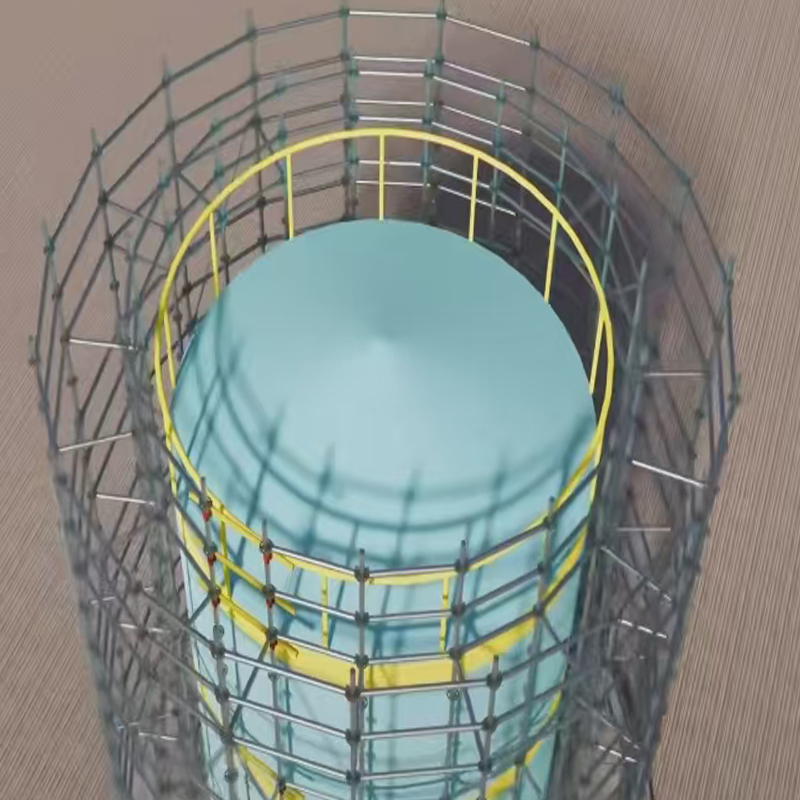
You cannot evaluate scaffolding solely by price when human lives depend on it. Complex curves generate immense, uneven tension forces across connection nodes. Material strength and manufacturing standards must remain your primary focus.
First, demand high-tensile steel construction. Standard carbon steel bends under radial stress. Require Q345 or Q355 grade high-yield steel for all load-bearing components. Second, always specify a galvanized ringlock scaffold. Curved structures expose rosette welds to uneven environmental stress. Hot-dip galvanization is strictly critical. You need a minimum zinc coating thickness of 80 microns. This layer protects microscopic weld fractures from aggressive corrosion.
Your chosen system needs a deep catalogue of specialized components. Standard bays alone will fail you. Look closely at the availability of the following parts:
Console Brackets (Side-brackets): These are essential tools. They step the platform closer to a receding or undulating facade.
Bridging Ledgers and Lattice Girders: Complex sites often prevent continuous base grounding. You require these components for spanning large foundational gaps safely.
Trapezoidal Decks and Gap Covers: Curved layouts inevitably create wedge-shaped voids. Evaluate the manufacturer's specific mechanical solutions for covering these gaps between rectangular decks.
Finally, demand rigorous load capacity certification. Assess their independent testing reports carefully. The system must maintain its structural classification, such as Heavy Duty. It must hold this rating even when built in non-standard, polygonal configurations. Look for strict compliance with EN 12810 and EN 12811 standards. Do not accept internal testing reports for complex applications.
Essential Curved Scaffold Component Checklist | ||
Component Category | Purpose on Curved Structures | Recommended Specification |
|---|---|---|
Rosettes | Allows multi-angle connections | 8-hole, 8mm thickness minimum |
Side Brackets | Closes facade gaps safely | 0.39m or 0.73m reach options |
Swivel Couplers | Connects non-standard tubes | EN 74 Class B certified |
Steel Planks | Creates walkable surfaces | Perforated surface, variable lengths |
Curved walls present massive challenges for anchoring and tie-ins. Standard flat ties simply do not work on curved or undulating masonry. Wind loads catch circular facades differently, creating distinct vortex shedding forces. You must evaluate how the system accommodates specialized anchoring methods. V-ties are highly recommended for stabilizing radial structures. Alternatively, crews can use standard scaffold tubes paired with swivel couplers. These elements ensure rigid stability against extreme wind loads.
Never attempt to procure ringlock scaffolding for curved facade projects without detailed digital planning. 3D modeling is absolutely critical. The vendor must provide exact component counts before shipping. We rely on software like AutoCAD, Scaffold Designer, or Revit. These programs simulate load paths and perform essential clash detection. They ensure ledgers do not physically intersect at tight inner radii. Missing this step leads to massive site delays.
Adoption and erection risks increase substantially on circular builds. Standard straight-line logic no longer applies. These configurations require higher initial skill levels from the erection crew. Ensure the manufacturer provides crystal-clear assembly manuals tailored to your exact curve. If necessary, contract on-site technical supervision for the first lift. A supervised initial base setup guarantees the polygon geometry starts flawlessly.
Sourcing standard equipment is easy. Sourcing complex geometric solutions requires a specialized partner. You must differentiate between commodity metal fabricators and true technical scaffolding partners. Anyone can weld steel tubes. Only a technical partner understands load distribution on a radius. Always prioritize vendors who supply customized structural calculations alongside their price quotes.
Traceability and rigorous quality control dictate site safety. You should look for permanently stamped components. These stamps identify the production batch and year. Request verifiable batch testing records for the steel yield strength. Transparent welding standards are equally vital. Ask vendors for their ISO 3834 welding certifications. This document proves their robotic welding process maintains consistency across thousands of rosettes.
Finally, scrutinize their inventory depth and lead times. A curved structure requires a heavily disproportionate number of small parts. You will need massive quantities of 0.73m ledgers, console brackets, and swivel couplers. Many vendors only stock standard 3-meter bays. Verify the supplier has deep, immediate inventory for these specific non-standard parts. You cannot afford to halt a high-value facade project waiting on small steel brackets.
Sourcing ringlock equipment for curved facade construction is less about buying metal. It is fundamentally about procuring geometric flexibility and structural certainty. Complex undulating structures demand precision engineering, robust load capacities, and highly adaptable components. By focusing on rosette mechanics and specialized gap-covering decks, you eliminate severe site hazards. Rigorous vendor vetting ensures your equipment withstands environmental stresses safely.
Your next step requires immediate action. Do not begin your procurement process by sending out a raw parts list. Instead, share your architectural CAD drawings directly with shortlisted suppliers. Ask them to propose a 3D scaffolding solution. Compare their specific component ratios, load calculations, and gap-bridging strategies. This technical approach guarantees you select a partner capable of executing your complex vision safely.
A: The specific bay lengths dictate your minimum radius. Using short 0.73m bays allows crews to navigate very tight circular radii. However, relying entirely on small bays increases your overall component counts and erection times. Planners balance radius tightness against total equipment costs by mixing short and medium bays strategically.
A: Planners use several methods to eliminate wedge-shaped voids. Crews often deploy custom trapezoidal steel decks designed specifically for curves. Alternatively, they use overlapping steel planks secured tightly. For complex bespoke angles, heavy-duty plywood cut-ins are utilized, provided they are locked down with specialized board retainers to prevent shifting.
A: Yes, hot-dip galvanization incurs a higher upfront procurement cost. However, the return on investment justifies the expense. Galvanization extends the system lifespan by decades. It lowers ongoing maintenance costs and performs significantly better in aggressive outdoor facade applications where rust creates severe structural liabilities.
A: Absolutely. Modular components handle about 95% of the overall geometry. For the remaining complex voids, standard scaffolding tubes and swivel couplers are fully compatible. Crews use these traditional fittings for final micro-adjustments, custom tie-ins, and bridging awkward angles where standard ledgers simply cannot fit.


